Our Kita · Concept
With all the senses – our concept
The kindergarten as a systemic and inclusive environment for living and learning – an excerpt.
Character of the kita
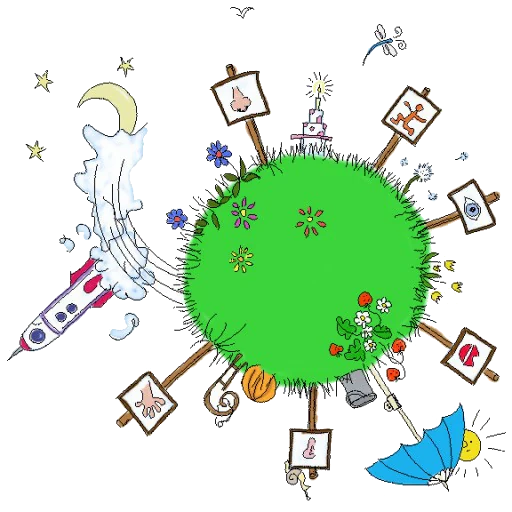
A world of the senses – the kindergarten as a systemic and inclusive environment for living and learning. The senses are the foundation and engine of life.
“Tell me and I forget, show me and I remember, let me do it and I understand.”Confucius
We see it as our task to enable every child entrusted to us to perceive and help shape their environment with all their senses – regardless of status, religion, background or disability. Through attitude, example, attention to developmental conditions, individual biography and the needs arising from it, we want to nurture children's abilities and strengthen and shape their sense of self. We work systemically and inclusively – we see the "whole system" and, wherever possible, involve everyone and everything in our work.
Who we are as a provider
Kinderwelt e.V. is a parent-run kindergarten and a registered association. This means educators and parents work closely together. Parents have many rights of participation and commit to working a certain number of hours at the kindergarten. The board is made up of four elected parents. More on the Parent-Run Kita page.
How Kinderwelt e.V. is made up
Our kita has room for 43 children. In two groups, the Sternenkucker and the Fühlwürmer, around 15 mixed-age children each are cared for, aged between one and around four years. The third group, the Spürnasen, is mostly of a single age and prepares children from around four years old for school.
Our goal is to experience the world with all the senses. We welcome different languages, nationalities and personalities.
Parents as partners
When signing the contract, parents commit to six parent-hours each, per kita year. This gives every parent the chance to actively take part in everyday kita life. Collaboration with parents is strengthened through parents' evenings, parent cafés, development discussions, noticeboards and (anonymous) surveys. Information, observations and documentation are stored securely in line with data protection law, and made available to parents at all times, so they can take an active part in the kita's development.
A kita for the senses
Through a wide range of materials and everyday impressions we stimulate children's development. Rules and structure give children a framework in which to enjoy themselves with joy and fun. Rhythm and structure create rituals they recognise, revealing greater freedom for mental and physical development. More on this: A Kita for the Senses.
Our educators
Our ten-strong team of educators currently includes graduate social pedagogues, graduate early-years pedagogues, qualified social administrators, teachers and state-certified educators. We train educators on the job. Our facility also has three integration specialists. You can see who's on the team here.
Our image of the child
As educators, we see every child as an independent individual with their own wishes, feelings, sensations and family history. We work with children consistently but respectfully, so they can develop important social skills. Children learn to resolve conflicts themselves and to integrate into a group. We observe children and support them in finding and acting on their own feelings, wishes and solutions.
We allow the youngest children their own sleep and eating rhythm. Nappy-changing is handled lovingly and sensitively, with plenty of time and space. In consultation with parents and children, we offer rest options suited to their stage of development (sleeping or resting). We respond lovingly to each day's needs – so older children can also get a place to sleep if they wish to, on request.
One of our great strengths is accompanying children as they develop into independent, self-reliant personalities. Children undergo their own developmental process at their own pace. We give children the time they need for this, along with the appropriate framework. We want to build a foundation with children that enables them to develop skills relevant to everyday life. Cognitive and mental abilities develop on this basis.
We regularly question and revisit our image of the child together, in team meetings. Various literature and materials are available to educators in the office for personal development. Internal and external further training is also supported by our provider.
Our understanding of education
Sensory perception is connected to every area of education and development in the life of a child aged 0 to 7. Our goal is, through conscious perception and stimulation of the senses, to shape children's life skills and make ourselves aware of them as educational goals:
- Sensory and perceptual skills
- Physical and movement skills
- Ability to form relationships
- Resilience
- Motivation
- Concentration, thinking, listening
- Sense of one's own ability
- Joy of life
- Values: openness, tolerance, solidarity, responsibility
- Orientation & self-regulation
- Tension and relaxation
- Sense of security
- Belonging and group relationships
- Self-confidence
- Cooperation
- Taking on roles and perspectives
- Communication, language
- Health awareness
It's therefore the educators' task to know and observe the children. Observations are regularly recorded using a method agreed by the team. Both the individual child and the group as a whole play an important role here. Based on these observations, and in exchange with colleagues, educators plan pedagogical activities. These combine children's interests and inclinations with age-appropriate experiences across all areas of education, and form the basis of our inclusive, systemic work.
As educators, we act as role models and partners: we nurture, accompany, help and support. We spark curiosity and let ourselves be inspired by the children. We keep developing, both independently and as a team.
The team creates the conditions for this together. We meet regularly, once a week in small group teams and once a month as a whole cross-group team. All information, planning and agreements are documented and stored, to enable thorough coordination. Together we coordinate and shape everyday kindergarten life systemically. We see ourselves as partners representing families' interests.
We support our shared goal of knowing and recognising each child with a common observation tool. Every educator has access to a record book, used at least once a year to illustrate each child's developmental stage using a traffic-light system. This book is based on the work “Entwicklung der Sinne” (“Development of the Senses”) by Ylva Ellneby, and takes into account the relevant areas of school readiness.
Children's development is documented together with the child, making learning processes visible for families and children, and kept securely – whether in a language-learning diary or otherwise, in line with data protection requirements. Through this form of documentation, children, parents and educators build confidence in reaching the next stage of development. This way, we honour the child's own process.
By recognising a child's educational intent, we can stimulate their abilities with ideas and materials. Parents are accompanied and supported in their parenting through development discussions and brief daily exchanges at drop-off and pick-up.
Daily routine & rituals
Sensory development rests on rhythm and repetition. This is provided through a conscious daily, weekly, monthly and yearly routine. Our current daily routine is on the Daily Routine page.
Monday is sports day, and we go to the nearby gym hall across groups at different times. Tuesday is toy day: children may bring a toy from home to show the other children and play with together in the group. Together we celebrate birthdays, mark the changing seasons, and celebrate festivals such as Carnival, Easter, our summer festival, the lantern festival, St Nicholas' Day, Christmas and more.
Settling-in concept
Our settling-in concept reflects the way our kita works: meeting children – and in this case parents too – exactly where they are. We respond to each family individually and want to accompany them through the transition from "just family" to "family and kindergarten". Parents of prospective children first have the opportunity to find out about us and our work on specific open days. They get an insight into our routines as well as the responsibilities of being a parent in a parent-run kita. Details can be found on the Settling In page.
Everyday integrated language support
through structured weekly plans, observation, movement and being a role model – build up › consolidate › stabilise › automate › apply
As a kita, we want to provide age- and situation-appropriate language stimulation every day, to increase the educational and learning opportunities of the children entrusted to us. In doing so, we bear in mind that:
- Children are born with the innate capacity to acquire language.
- Language develops above all through intrinsic motivation and rich opportunities.
- Every child has their own stage of development and individual learning strategies.
- Children learn language through experiences with all the senses, and through extensive daily movement activities.
- A trusting and positive relationship with everyone involved is essential.
- We see ourselves as active and empathetic listeners, and we're always developing further.
- Should difficulties arise due to illness (e.g. hearing difficulties from frequent middle-ear infections, mutism, deafness, dyslalia or others), we consider it our duty to seek help from third parties (doctors, speech therapists, audiologists …).
- We strive for correct language use, and act as a language role model (authentic and empathetic).
- We actively involve parenting partners in our work (parents' evenings, themed evenings, development discussions and suggestions).
- We foster a culture of welcome.
Our facility cares for children who speak German as their native language, bilingual children, and refugee children who speak other languages. At the moment, around nine different languages are woven into everyday life at our facility. Our activities are geared to children's developmental stage and interests, and designed to be appropriately challenging.
Since 2019 we've also worked according to the "Alltagsintegrierte Sprachbildung und Sprachförderung – HIT" method (everyday-integrated language education and support). All pedagogical staff at our facility have been certified in this through further training.
Safeguarding concept
Kindergarten is a place where girls and boys have the chance to experience themselves as part of a community in which everyone's needs matter, and where the big, strong or rough don't simply prevail. Alongside a lived, preventive approach to parenting, this includes actively engaging with the topics of violence, sexual abuse and assault, in order to reduce fears and uncertainty, to stay alert, and to take the right steps whenever abuse is suspected.
The attitude of everyone providing care is grounded in professionalism and expertise, and cannot be based on personal beliefs alone. Professionalism means that personal opinions and attitudes must not, on their own, determine how children's sexual behaviour is handled – rather, expert knowledge must form the basis.
The protection of the individual child is always at the centre of what we do – good parenting is the best protection!
We have formulated our own safeguarding concept, based on the "Berlin-wide standardised risk assessment in cases of suspected endangerment to the wellbeing of a child or young person".
Questions about our concept?
Feel free to talk to us – for example at a no-obligation get-to-know-you visit. Get in touch